RangeNav: from synthetic pretraining to real-world navigation.
Abstract
Autonomous mobile robots operating in dense crowds and cluttered sites require 360° perception to react to surrounding hazards. While panoramic LiDAR offers full-surround coverage, learning representations within reinforcement learning (RL) is sample-inefficient under sparse rewards, and existing 3D pretrained point-cloud encoders are too memory-heavy for massively parallel RL simulation.
We present RangeNav, a compact (183k parameters) LiDAR range-image encoder pretrained entirely on synthetic data. RangeNav uses anisotropic convolutions and circular padding to handle the extreme aspect ratio and azimuthal seam of range images. We pretrain the network using a navigation-aligned objective combining range reconstruction, semantic segmentation, and bird’s-eye-view (BEV) prediction, then freeze it for policy learning.
In simulation, adding semantic and BEV supervision increases success rates over a reconstruction-only baseline by an average of 32.03 and 23.73 percentage points (pp) in procedurally generated training and out-of-distribution realistic test environments, respectively. Zero-shot real-world deployments on a Unitree B2-W quadruped demonstrate robust navigation through dense crowds, low-light settings, and construction zones where limited-field-of-view depth policies struggle. Code and models will be open-sourced.
Method
We generate LiDAR observations from TartanGround, pretrain a compact encoder with three complementary objectives, and freeze it for policy learning. The decoder heads are used only during pretraining.
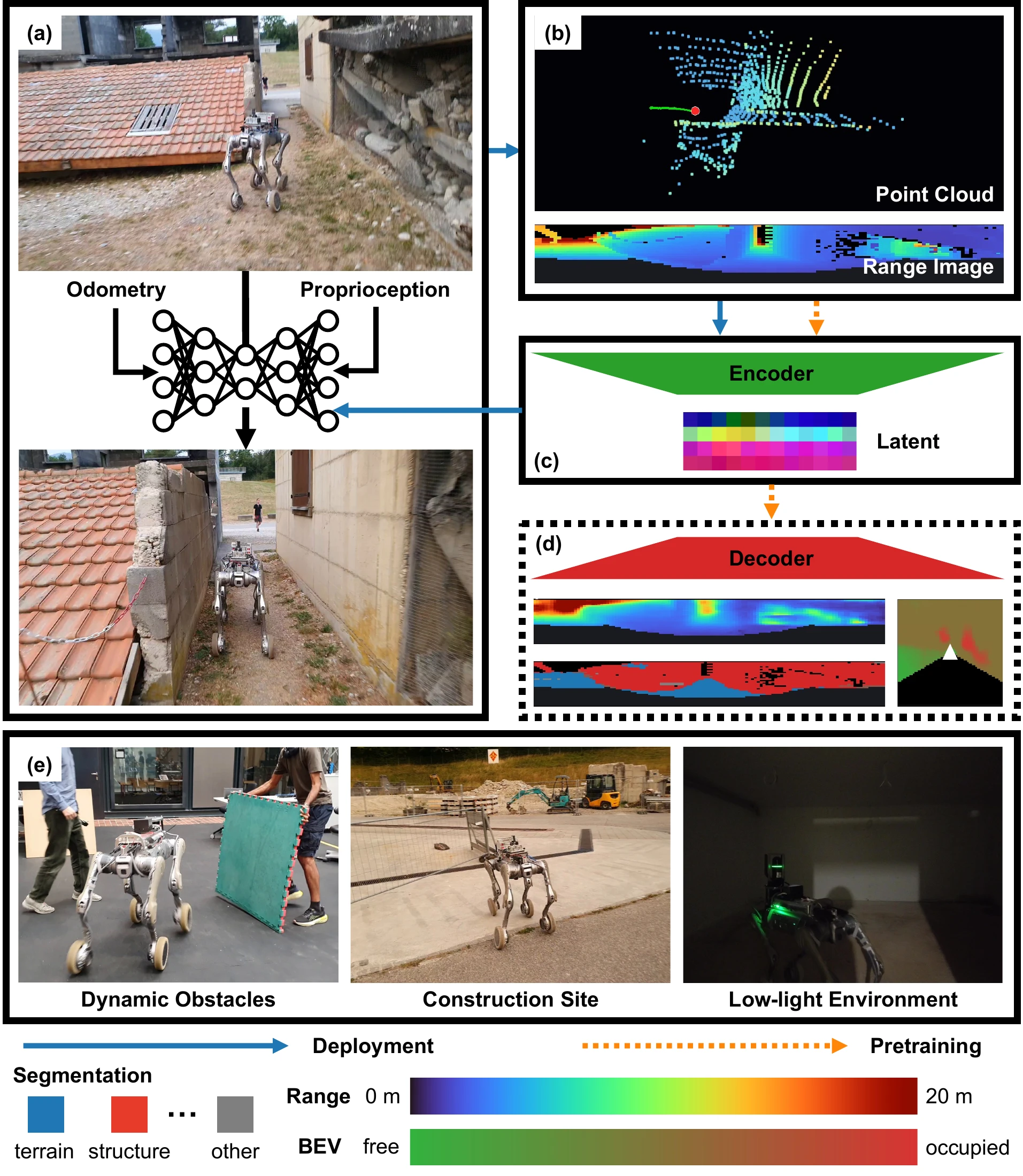
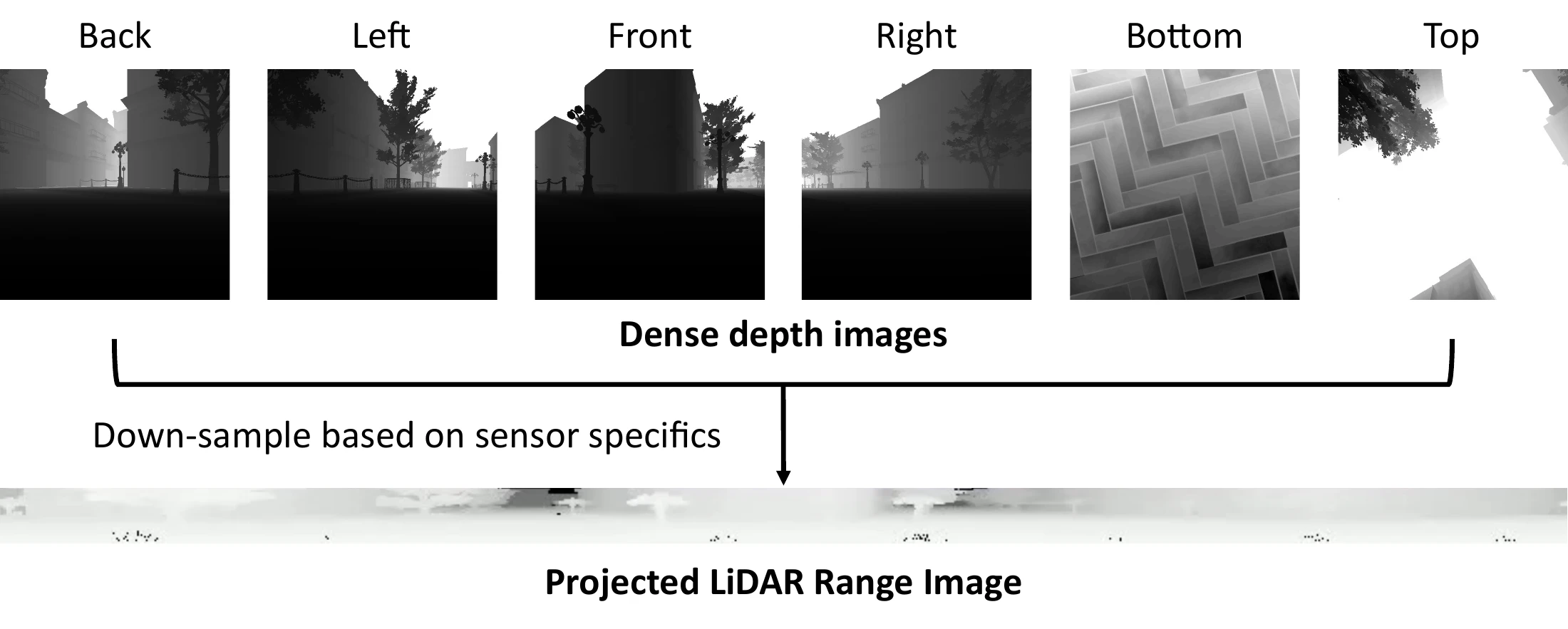
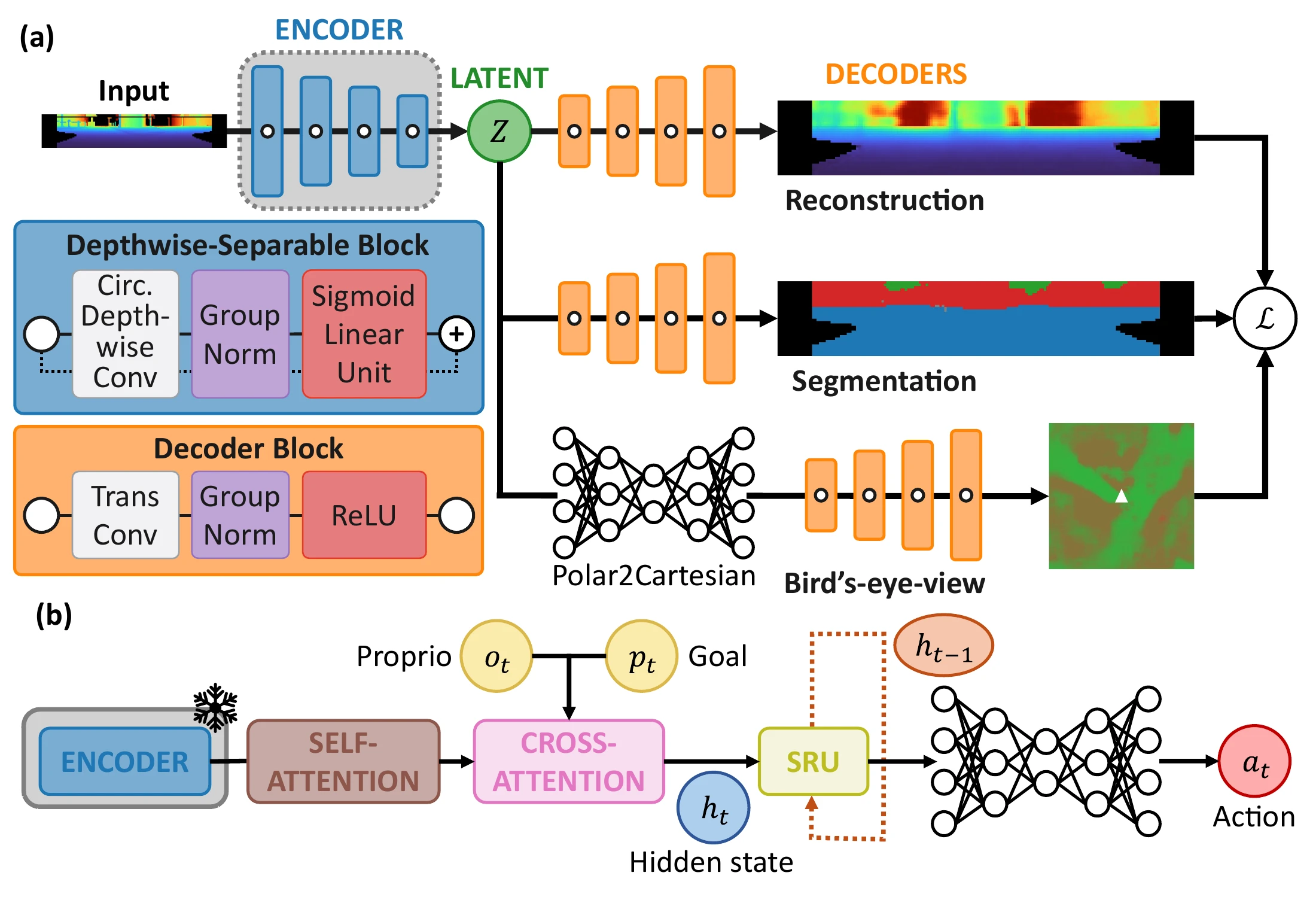
Key insight: Geometry, semantic labels, and top-down occupancy teach the encoder which scene information matters for navigation.
Real-World Navigation
The system runs onboard a Unitree B2-W with a 32-beam RoboSense Helios LiDAR and Jetson AGX Orin. Demonstrations cover pedestrians, construction sites, narrow passages, and low-light environments.
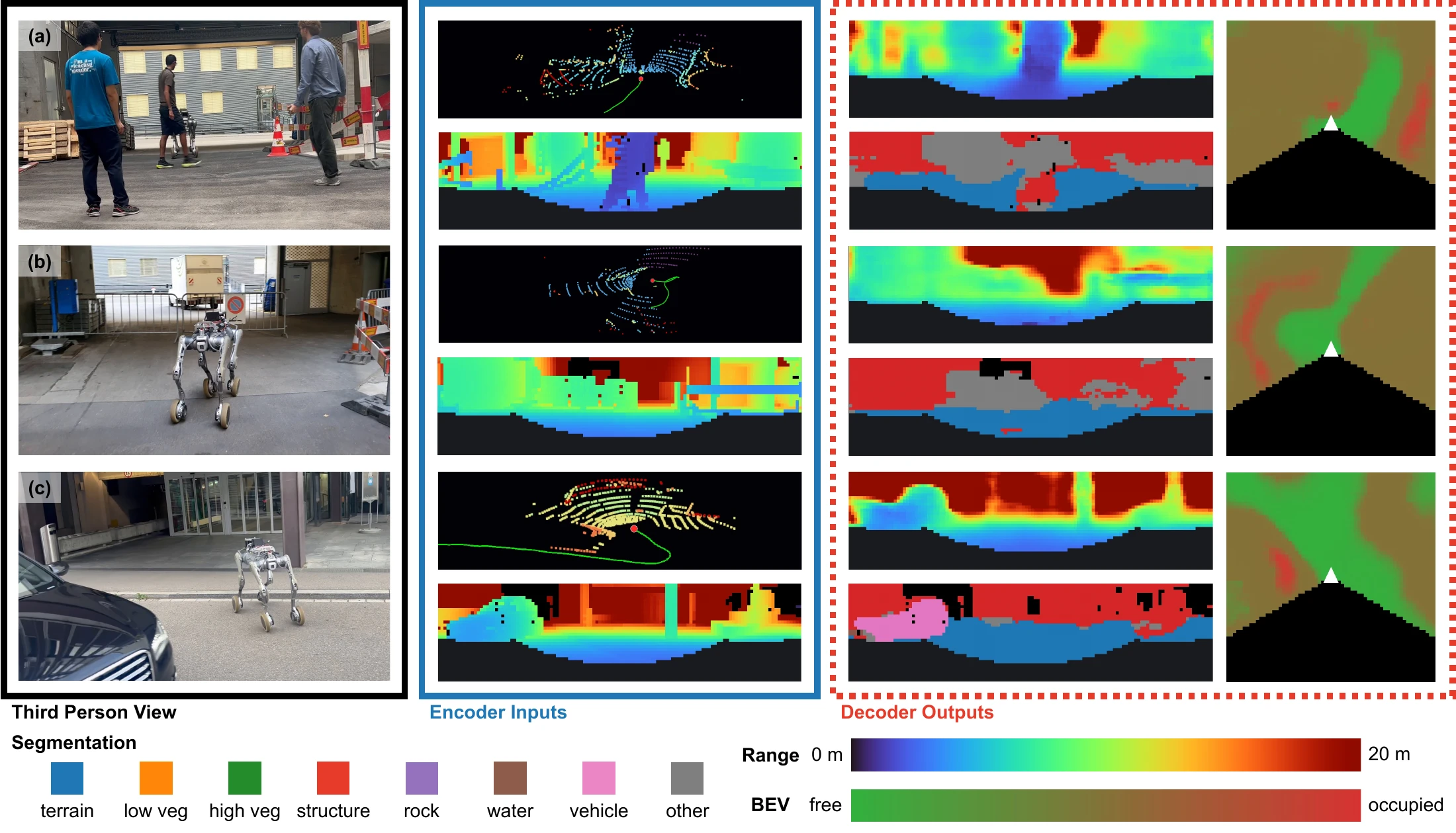
Key insight: The same encoder and policy transfer from simulation without real-world fine-tuning.
Simulation
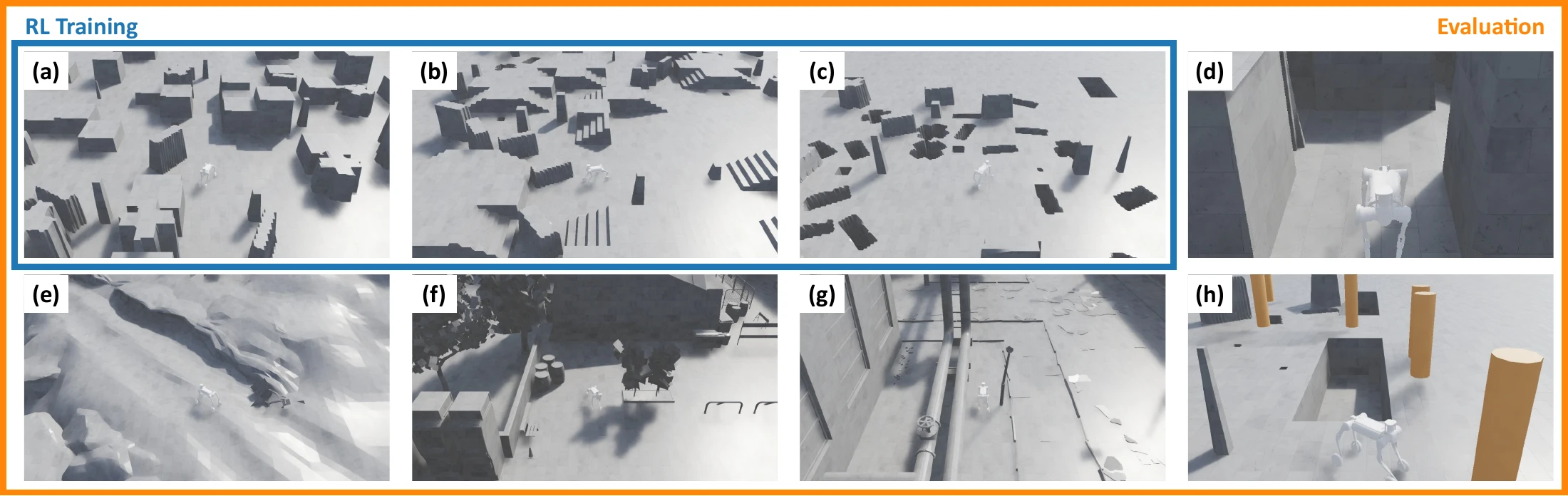
Training uses procedural mazes, pillars, stairs, and pits. Evaluation adds held-out scenes, starts close to walls, and moving pedestrians. Each environment uses 1,024 fixed start–goal scenarios.
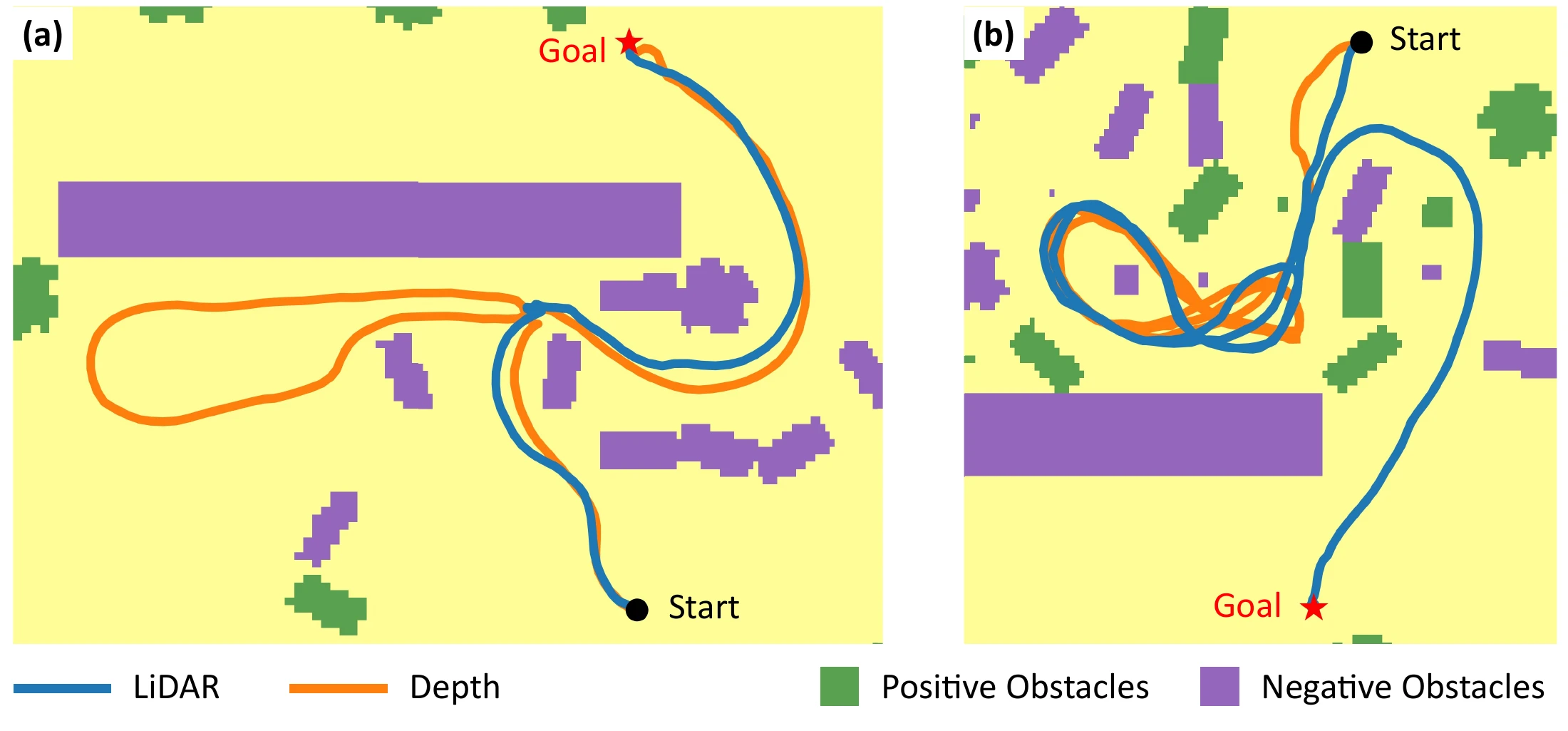
Key insight: Panoramic LiDAR improves success over front-facing depth in side-wall and dynamic-obstacle scenarios. Depth remains stronger on pillars, stairs, and AbandonedCable.
Results
Adding semantic and BEV supervision improves average success over reconstruction alone by 32.03 percentage points on the base mixture and 23.73 percentage points on held-out TartanGround scenes.
| Input / pretraining | Base mixture | TartanGround | Side-wall | Dynamic |
|---|---|---|---|---|
| Depth baseline | 95.36 | 72.95 | 79.98 | 77.64 |
| LiDAR · Reconstruction | 63.43 | 49.44 | 61.52 | 63.18 |
| LiDAR · + Semantics | 88.50 | 67.43 | 85.94 | 78.03 |
| RangeNav · + BEV | 95.46 | 73.17 | 88.87 | 79.49 |
Success rate (%). Base mixture and TartanGround each average four environments; policies are trained for 15,000 iterations.
The 183k-parameter encoder supports 1,920 parallel environments and 1,469 training steps/s on one RTX 4090.
Detailed results and ablations
Per-environment success
| Environment | Reconstruction only | RangeNav |
|---|---|---|
| Maze | 78.81 | 96.88 |
| Pillars | 80.08 | 98.54 |
| Stairs | 68.07 | 94.34 |
| Pits | 26.76 | 92.09 |
| AbandonedCable | 51.46 | 81.45 |
| Gascola | 29.98 | 51.56 |
| ModernCityDowntown | 46.39 | 86.13 |
| Market | 69.92 | 73.54 |
Route efficiency
| Metric | Depth | LiDAR |
|---|---|---|
| Success weighted by path length (%) ↑ | 84.53 | 85.11 |
| Time to goal (s) ↓ | 16.57 | 15.19 |
Aggregate values across maze, pillars, stairs, and pits.
Encoder scalability
| Encoder | Parameters | Max. RL environments | Throughput (steps/s) |
|---|---|---|---|
| Utonia | 137M | 48 | 19 |
| Sonata | 108M | 64 | 30 |
| LitePT-S | 12.7M | 96 | 75 |
| RangeNav | 183k | 1,920 | 1,469 |
Pretraining and architecture ablations
| Pretraining | Success |
|---|---|
| Sonata distillation | 85.06 |
| Utonia distillation | 80.98 |
| RangeNav objectives | 92.38 |
| Variant | Parameters | Success |
|---|---|---|
| RangeNav · 3 × 9 | 183k | 92.38 |
| 3 × 3 stem | 182k | 85.96 |
| 2× channel width | 462k | 91.53 |
| RegNet-FPN | 5.8M | 70.46 |
The distillation and architecture ablations use a shorter 5,000-iteration RL budget and should not be directly compared with the main results.
Resources
Code and pretrained models are coming soon.